
110 tweet ideas: what to tweet about, by category
xVirals · Updated · 13 min read
Staring at an empty compose box is usually a topic problem, not a writing problem. This guide gives you 110 fill-in-the-blank prompts in 11 categories, a quick way to choose between them, a test for whether an idea is worth posting, and the few facts X publishes that matter when you pick ideas. The prompts are starting sentences written for this guide, not real posts and not a promise of results. Replace every [bracket] with something that is true for you, because the details are what make a post yours.
What should I tweet about?
Start from three buckets and look for overlap: what you know (your job, your field, your hobby), what you went through (stories, mistakes, changes) and what you think (opinions, predictions, questions). A good idea almost always sits where at least two of the three meet, such as a mistake you made in your field that changed your opinion.
Then make it small. “Marketing” is a topic. “The one headline I rewrote five times last week” is a post. If you are stuck, choose a category below, copy one prompt into your notes app and fill in a single real detail before you write a word of the tweet.
Tweet ideas about your work and expertise
The easiest posts to write are the ones only you can write because you did the work.
- The one thing I wish I knew before my first [job or project] in [field].
- A mistake I made in [field] that cost me [time or money], and what I do now.
- If I could only keep one tool for [task], it would be [tool], because [reason].
- What a normal day as a [role] looks like, hour by hour.
- Three things beginners in [field] spend time on that don't matter yet.
- A myth about [field] I used to believe.
- How I decide what to say no to at work.
- The checklist I run before [task], and why each line is there.
- The question I get asked most about [field], and my honest answer.
- One change I made to my workflow this month: before and after.
Story and personal tweet ideas
Stories are easy to follow and hard to copy. Keep one scene, one lesson, no moral at the end.
- A small moment that changed how I think about [topic].
- The worst advice I ever got, and who gave it.
- What I was doing exactly a year ago versus now.
- A failure I can only laugh about now.
- The first time I [did something new], in three sentences.
- A habit I dropped that I don't miss.
- Something a stranger said to me that stuck.
- The best decision I made with very little information.
- Something I am still bad at, and what I am doing about it.
- A book, film or person that changed one belief of mine, in one sentence.
Opinion and hot take ideas
A strong opinion needs one reason attached. Without the reason it reads as noise.
- Unpopular opinion: [common belief] is overrated, because [reason].
- I disagree with [popular advice]. Here is what I would say instead.
- [Thing] isn't the problem. [Real problem] is.
- Everyone says [X]. In my experience the opposite is closer to true.
- Stop [common behaviour]. Start [alternative]. One line on why.
- The most overrated skill in [field], and the underrated one next to it.
- A rule in [field] that deserves to be broken.
- Something I will defend even though it is unfashionable.
- A trend in [field] I think will fade, and why.
- A take on [this week's news] with one fact behind it.
Educational and how-to tweet ideas
Teaching in public builds trust faster than announcing that you are an expert. Keep each tweet to one idea. For longer lessons, see how to write a Twitter thread.
- How to [task] in [number] steps, in plain language.
- [Concept] explained to a friend who has never heard of it.
- A before and after of [thing]: the weak version and the fixed version.
- The [number] questions I ask before [decision].
- A shortcut for [task] that saves me [time].
- [Number] terms in [field] and what they actually mean.
- The most common mistake in [task] and the one-line fix.
- A mini case study: what I did, what happened, what I would change.
- A free resource that taught me [skill], and the part worth your time.
- Everything I know about [topic], one lesson per tweet, as a thread.
Question and poll ideas
Questions work when they are easy to answer in one line and specific enough that people have an answer ready. “Thoughts?” is not a question.
On polls, X's help center gives the limits: the question can use the normal character count, each option can be up to 25 characters, there can be up to four options, and a poll lasts from 5 minutes to 7 days (1 day by default). Photos can't be added to a poll, and votes are private, so you see totals but not who voted for what.
- What is one [tool or habit] you would recommend to someone starting [thing]?
- [A] or [B]? Pick one and tell me why.
- What was the most useful thing you learned this year?
- What did you believe about [field] that turned out to be wrong?
- If you had one hour to learn [skill], what would you do?
- Poll: How do you [habit]? Options: [A], [B], [C], [D], each under 25 characters.
- What small thing makes [daily task] better for you?
- Which [thing] are you about to stop using?
- What should my next thread answer? Reply with your question.
- What do you wish more people talked about in [field]?
Funny and relatable tweet ideas
Humour is the most personal category, so let your own voice carry it. These work best when the situation is specific.
- The difference between what I planned for today and what happened.
- Things that sound fake but are normal in [job or field].
- How people picture [job] versus what it actually is.
- A conversation with myself at [time], written as a dialogue.
- The unwritten rules of [situation].
- The [type] of person in every [group chat or meeting].
- An over-the-top complaint about something tiny.
- The stages of [shared experience], in order.
- Describe [your job or hobby] using only phrases from [another world].
- A screenshot from your own phone with a one-line caption that makes it make sense.
Tweet ideas for builders, founders and creators
Building in public works because people follow a story with a next step. Say what you are doing and what is not working yet.
- What I am building this week, in one sentence, and the next step.
- A number from my project I don't know how to feel about.
- A decision I am stuck on: which would you choose?
- What I would do differently if I launched [project] again.
- One feature I cut, and why.
- How I got my first [reader, user or client].
- The tool stack I use for [project], and what I would drop.
- What I learned from [number] weeks of posting consistently.
- What I learned from one user complaint.
- A behind-the-scenes screenshot of my work, with one thing I would improve.
Tweet ideas about tech and AI
Specific beats hype. Say what you asked, what you checked afterwards and what was wrong.
- A task I handed to an AI tool, what I checked afterwards, and what it got wrong.
- The prompt I use most, and why it works.
- An AI tool I stopped using and what I replaced it with.
- What AI is good at in [field] and what still needs a person.
- A piece of [tech] news explained in two sentences.
- [Tool A] versus [tool B] for one specific job.
- Something I automated this month and what I still do by hand on purpose.
- A beginner mistake with AI tools I see often.
- A small script, shortcut or setting that saved me time, and how to set it up.
- What I would learn first if I started [tech skill] today.
Recurring series ideas
A series answers “what do I post today?” in advance. Pick one or two and keep the format the same each time so people recognise it.
- A Monday question that people answer in the replies.
- Friday wins: three things that went right this week.
- One tool, resource or idea a day, with one sentence on why.
- Three things I learned this week, every Sunday.
- Myth versus fact, every Wednesday.
- A before and after in each post.
- Ask me anything about [topic], on a fixed day of the month.
- Lesson [number] of [total] on [topic].
- Book of the month: one takeaway in one line.
- Mistake of the week, and the fix.
Tweet ideas for brands and businesses
Brand accounts get attention by being useful or human, not by announcing everything. Ask permission before you mention a customer.
- A behind-the-scenes look at how [product or service] is made.
- An honest answer to the question customers ask most.
- A customer problem and how we solved it, with permission.
- Something we got wrong and what we changed.
- A myth about our industry.
- Meet the team: one person, one detail.
- What is new this month, one line each.
- A short explainer of one feature, with a screenshot.
- Our process in [number] steps.
- A specific thank-you to a customer, partner or supplier.
What do I tweet when I have no idea? Reply and quote ideas
Replies are the lowest-pressure way to post, and they put you in front of other people's audiences. Write each one for the post it sits under; the same line pasted under many posts is exactly what X's spam rules describe.
- Reply with one experience that supports or complicates the post.
- Quote a post with the one thing it missed.
- Give a real answer to a question someone asked under a bigger account.
- Share a source that extends someone's post.
- Ask a specific follow-up question instead of “great post”.
- Summarise a long post or thread in one tweet.
- Correct a small error politely, with a source.
- Add a counter-example.
- Share how you applied someone's advice and what happened.
- Congratulate someone with specifics, not “congrats”.
Is my idea worth posting?
Run a draft idea through this list before you write it. If you can tick most lines, write it.
Idea test
0/7Tick each line that is true for your account.
How do I turn an idea into a finished tweet?
- Write the idea as one sentence with the real detail filled in.
- Lead with the specific part. Put the number, the scene or the claim first and the context second.
- Cut to one point. If you have a second point, save it as a separate post.
- Check the length with the character counter. The standard limit is 280 characters. X Premium subscribers can write longer posts, up to 25,000 characters, but a short, strong opening works at any length.
- Read it out loud. Change anything you would not say.
- Publish it yourself, then save the best ones as templates for next time.
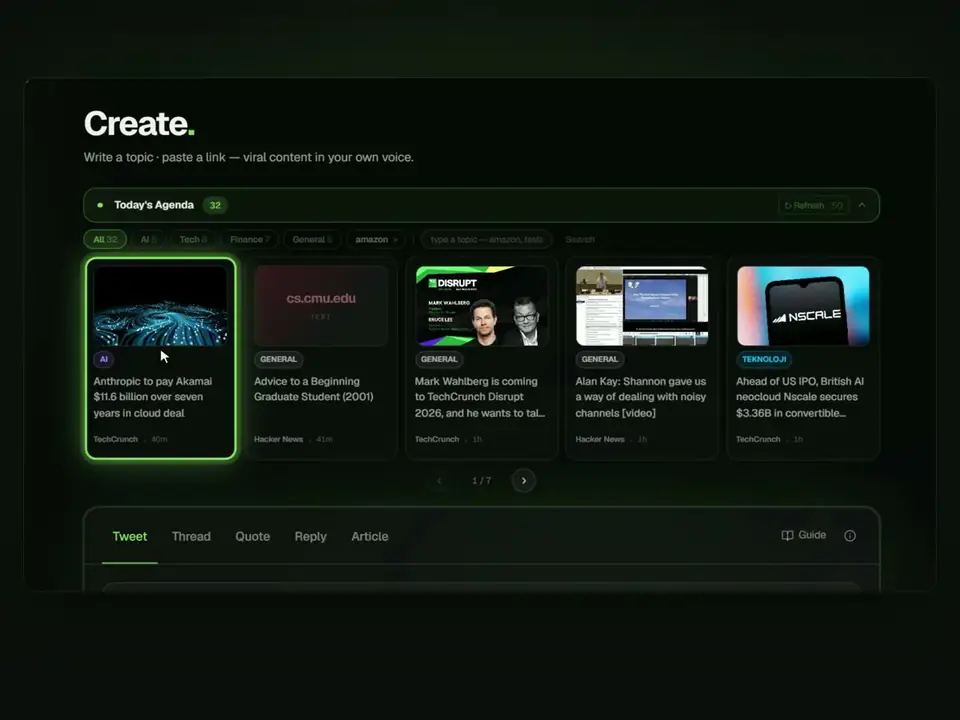
If you want a draft to react to, xVirals is an AI writing assistant that learns your style from your own public posts and drafts tweets, replies and threads in your voice. It never posts for you: you edit and publish every draft. See how to write tweets in your own voice and how to write viral tweets for more.
Which ideas does X's ranking favour?
X has published the source of its For You feed. Its README lists the reactions the ranking model predicts for a post: favorite, reply, repost, quote, share (including by DM and by copying the link), profile and link clicks, dwell time and following the author. It also lists negative ones: not interested, muting the author, blocking the author and reporting.
That does not tell you which idea will work, and X does not say how the pieces are weighted in a way you can plan around. What it does suggest is practical. Ideas that give a specific person a reason to answer, share or follow are aiming at signals the model predicts, and posts that people hide, mute or report push the other way. One more detail from the same README: before scoring, a filter removes posts older than 48 hours from the For You candidates, so a good idea is worth posting fresh rather than counting on an old post coming back.
Frequently asked questions
What should I tweet about?
Start from what you know, what you went through and what you think, and pick a small, specific moment from your own week. Then use one of the prompts above and replace each bracket with something true for you.
How many times a day should I tweet?
There is no verified number. What matters more is posting things you would be glad to see under your name. Pick a pace you can keep, and use a recurring series so you always know what is next.
What should I tweet if I have no followers?
Reply thoughtfully to posts in your field, share small things you learned and answer questions other people ask. Replies put your words in front of someone else's audience. Write each one for the post it sits under.
How do I come up with tweet ideas fast?
Keep a running note of things that surprised, annoyed or helped you, and turn one line into a post using a prompt from this guide. The questions you are asked in real life are a good source.
How long can a poll on X be, and how many options?
According to X's help center, a poll can have up to four options of up to 25 characters each, and lasts from 5 minutes to 7 days, with 1 day as the default. You can't add photos to a poll.
Should I use AI to come up with tweet ideas?
AI is useful for drafting and for suggesting angles, but the experience behind the post has to be yours. Use it to turn your idea into a draft, then rewrite it until it sounds like you and post it yourself.
Can I reuse the same idea?
Yes, with a new detail. The same lesson told through a different moment is a different post. What X's spam rules discourage is repeating identical or nearly identical posts.
Do these prompts work for threads?
Yes. Every list in this guide can become a thread: put the setup in the first tweet and one point per tweet after it. See the thread guide and the thread generator for the mechanics.